Mount Olympus in Greek Mythology
Rising dramatically above northern Greece, Mount Olympus has held a unique place in human imagination for over three millennia. In ancient Greek belief, Olympus was not merely a mountain but the divine dwelling place of the Olympian gods. Its towering peaks, often veiled in cloud, came to represent the boundary between the mortal world and the realm of the divine.
From early epic poetry to later religious practice, Olympus stood as a symbol of cosmic order, authority, and permanence, shaping how the ancient Greeks understood both the gods and their relationship with the natural world.
The Home of the Olympian Gods
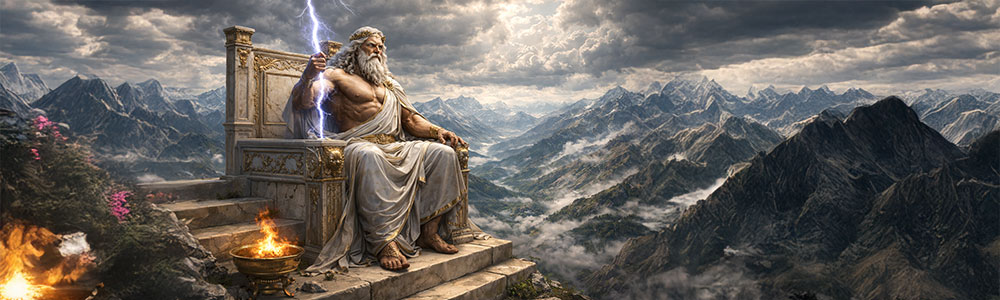
In Greek mythology, Mount Olympus was believed to be the eternal residence of the twelve Olympian gods, ruled by Zeus, king of the gods and god of the sky and thunder. From Olympus, the gods were thought to observe human affairs, intervene in mortal lives, and maintain balance in the universe.
Ancient poets described Olympus as a place untouched by weather or decay. In the epics attributed to Homer, Olympus is portrayed as serene and everlasting, distinct from the unstable and fragile world of humankind. This idealised vision reinforced the idea of the gods as immortal beings, removed from human suffering yet deeply influential in human destiny.
A Sacred Landscape Between Earth and Sky
Olympus was not imagined as a single summit but as a vast and sacred landscape. Its sheer height and frequent cloud cover contributed to the belief that the gods were physically present yet hidden from mortal sight. The mountain became a natural axis linking earth and sky, a place where divine presence felt tangible without being directly accessible.
This separation was essential to Greek religious thought. Mortals could honour the gods and seek their favour, but Olympus itself remained forbidden and unattainable, reinforcing the hierarchy between human and divine existence.
Worship, Ritual, and the Sanctuary of Dion
While the gods were believed to dwell on Olympus itself, worship took place at its foothills. The most important religious centre associated with the mountain was the ancient city of Dion, dedicated primarily to Zeus and the Olympian gods.
Here, festivals, sacrifices, and processions connected the human community to the divine presence of Olympus. Rulers of ancient Macedonia, including Philip II and Alexander the Great, are known to have offered sacrifices at Dion before major military campaigns, underlining the mountain’s political as well as religious significance.
Olympus in Ancient Literature and Belief
The mythology of Olympus is preserved through some of the most important texts of ancient Greek literature. Hesiod’s Theogony describes the genealogy of the gods and establishes Olympus as the centre of divine authority following Zeus’s victory over the Titans. Together with Homeric poetry, these works shaped a shared mythological framework that endured across the Greek world for centuries.
Through these stories, Olympus became more than a physical location. It was an idea — a symbol of order, justice, and divine oversight — embedded deeply in Greek cultural identity.
From Ancient Myth to Modern Landscape
With the spread of Christianity, the ancient religious practices associated with Olympus gradually faded. Yet the mountain never lost its symbolic power. Today, Mount Olympus stands as both a natural monument and a cultural landmark, protected as a national park and UNESCO Biosphere Reserve.
For modern visitors, Olympus remains a place where mythology, history, and landscape converge. The mountain continues to inspire awe, inviting reflection on humanity’s long-standing relationship with nature, belief, and imagination.